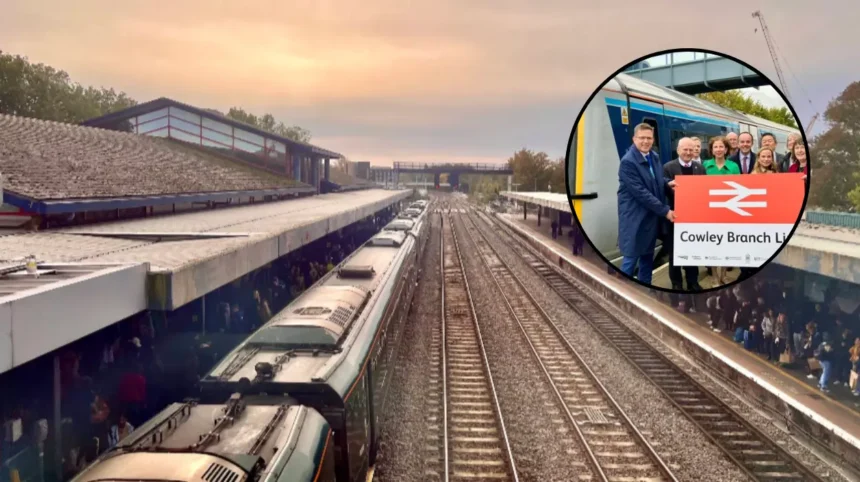
Key Points
- Allocation of Funds: Millions of pounds raised in South Oxfordshire are earmarked for expenditure on Oxford rail projects rather than being channeled into local infrastructure needs elsewhere in the county.
- Community Frustration: Local residents, stakeholders, and regional advocates have expressed deep concern and disappointment over the diversion of funds.
- Ignored Local Projects: Prominent regional transport schemes, most notably the long-awaited Wantage and Grove train station project, risk being sidelined or underfunded as a consequence of the capital distribution.
- Infrastructure Disparities: The decision highlights ongoing regional tensions regarding how funds generated from development and growth in areas like the Science Vale are distributed across urban versus rural or semi-urban localities.
- Attribution and Reporting: Exclusive details regarding the allocation and the surrounding community backlash were brought to light by reporter Matthew J C Evans through regional media coverage.
Oxford (Oxford Daily) July 25, 2026 — Growing apprehension has gripped parts of Oxfordshire following revelations that millions of pounds raised within South Oxfordshire are destined to be funnelled into central Oxford rail developments, bypassing smaller local connectivity priorities. The financial strategy, which prioritises major metropolitan rail initiatives over peripheral community transport demands, has ignited a fierce debate regarding geographic equity, infrastructure planning, and the true distribution of economic benefits derived from regional development. As detailed in an exclusive report by Matthew J C Evans of The Oxford Mail, the decision has left local communities—particularly those surrounding historical transport desert zones—questioning why capital generated locally is not being leveraged to solve acute regional transit deficits, such as the persistent campaign for a new railway station serving Wantage and Grove.
- Key Points
- Why are Oxfordshire residents concerned about rail funding?
- Which local projects are missing out on the multi-million-pound investment?
- How does the capital allocation impact wider regional transport goals?
- What are local stakeholders saying about the funding disparity?
- What lies ahead for Oxfordshire’s contested rail infrastructure?
Why are Oxfordshire residents concerned about rail funding?
The core of the unfolding controversy lies in the allocation mechanics of regional development funds. As reported by Matthew J C Evans of The Oxford Mail, local taxpayers and community representatives are increasingly anxious that financial resources generated via commercial and residential expansion within South Oxfordshire are being systematically absorbed by high-profile urban rail schemes in Oxford proper, rather than addressing localized transport poverty.
For years, infrastructural growth linked to the wider Science Vale and surrounding economic hubs has generated significant capital contributions. However, communities situated further south have routinely argued that the tangible benefits of these funds fail to trickle down to their immediate neighborhoods. The latest revelations cement these fears, demonstrating that large multi-million-pound pots are locked into centralized transit enhancements instead of being deployed to bridge the infrastructure gap in growing market towns and rural settlements.
Which local projects are missing out on the multi-million-pound investment?
Among the primary casualties of this centralized funding focus is the long-advocated scheme for a railway station serving Wantage and Grove. As highlighted by Matthew J C Evans of The Oxford Mail, local campaigners have spent decades pushing for the reinstatement or construction of a rail facility to service the rapidly expanding population in the Wantage and Grove area.
Despite substantial housing growth and a corresponding spike in commuter demand, residents in these areas continue to rely heavily on congested local road networks or face lengthy commutes to access the nearest operational railway stations, such as Didcot Parkway. Critics of the current funding model argue that if millions of pounds are actively being extracted or influenced by South Oxfordshire developments, a proportionate slice should directly address the glaring absence of basic rail connectivity in places like Wantage and Grove. Instead, local taxpayers feel that their economic contributions are being swallowed up to subsidize Oxford’s urban transport upgrades at the expense of outlying suburban and rural needs.
Explore More Local Oxford News
Oxpens River Bridge Footpaths to Close in Oxford 2026
Ebola Vaccine Trial First Volunteer Oxford 2026
How does the capital allocation impact wider regional transport goals?
The debate over where Oxfordshire’s rail millions are spent touches on a deeper structural dilemma facing county planners: how to balance the massive infrastructural demands of a growing university city against the urgent mobility needs of surrounding towns. Oxford’s railway network has historically required significant modernization to handle rising passenger numbers, freight requirements, and regional connectivity demands. Schemes focusing on track expansions, platform renewals, and bottleneck reductions around Oxford station have routinely commanded massive financial backing from both national government grants and local development levies.
Nevertheless, as noted in reporting by Matthew J C Evans of The Oxford Mail, this centralized focus creates a profound sense of disenfranchisement outside the ring road. Transport planners and local councils frequently find themselves trapped between competing priorities. On one hand, enhancing Oxford’s main transport hub promises broader economic multipliers for the entire county by improving regional transit flow. On the other hand, neglecting grassroots projects like the Wantage and Grove station risks locking thousands of residents into car-dependent lifestyles, directly contradicting broader county and national carbon-reduction objectives.
What are local stakeholders saying about the funding disparity?
Community leaders, parish representatives, and local transport action groups have voiced mounting frustration over what they perceive as a systemic urban bias in infrastructure spending. As documented by Matthew J C Evans of The Oxford Mail, local discussions have increasingly centered on whether current funding mechanisms genuinely serve the entire county or if they disproportionately reward major urban nodes at the expense of peripheral growth zones.
Critics argue that the planning obligations and developer contributions collected under frameworks designed to offset the impacts of regional expansion should be reinvested as close to the source of impact as possible. When millions of pounds are instead reallocated to major rail projects miles away, it undermines public trust in local government planning processes. Residents and local councillors are demanding greater transparency regarding how financial decisions are reached, insisting that communities bearing the brunt of local housing and commercial expansion deserve a direct say—and a direct share—in infrastructural windfalls.
What lies ahead for Oxfordshire’s contested rail infrastructure?
As pressure mounts following the revelations brought to light by Matthew J C Evans of The Oxford Mail, local authorities and transport bodies face an uphill battle to restore confidence among disillusioned taxpayers. The debate has catalyzed renewed calls for a comprehensive review of how regional infrastructure funds are prioritized and distributed across Oxfordshire.
Whether public outcry will force a re-evaluation of current spending commitments remains to be seen. However, the political cost of sidelining vital local ambitions, such as the Wantage and Grove train station, is becoming increasingly clear. For communities living within the shadow of major rail investments yet reaping none of the benefits, the demand for a fairer, more decentralized approach to public transport funding has never been more urgent.