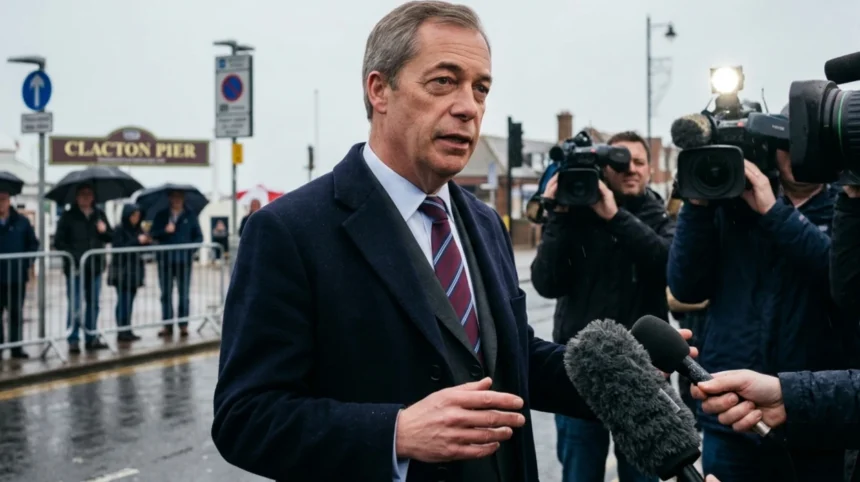
Nigel Paul Farage is a prominent British politician, media broadcaster, and Leader of Reform UK who has significantly altered the modern political landscape of the United Kingdom. Born on April 3, 1964, Farage spent decades orchestrating the political movement that led to the withdrawal of the United Kingdom from the European Union, a historical process known as Brexit. His career spans fourteen years within the Conservative Party, followed by leading roles in the UK Independence Party, the Brexit Party, and Reform UK. Operating primarily outside traditional Westminster structures for most of his life, Farage advanced right-wing populism, anti-immigration policies, and Euroscepticism into mainstream British governance.
- Who is Nigel Farage and what is his background?
- How did Nigel Farage influence the Brexit referendum?
- What political parties did Nigel Farage lead after UKIP?
- The Brexit Party Transition
- The 2019 European Parliament Election
- The Formation and Ideology of Reform UK
- How did Nigel Farage perform in British general elections?
- What led to Nigel Farage’s resignation from Parliament in July 2026?
- What are Nigel Farage’s core political and economic stances?
- How has Nigel Farage utilized the media to build his profile?
- Conventional Broadcasting Roles
- Reality Television and Public Relations
- Digital Strategy and Social Media
- What is Nigel Farage’s broader geopolitical and international impact?
- What are the main criticisms and controversies surrounding Nigel Farage?
- What is Nigel Farage’s long-term legacy in British politics?
Who is Nigel Farage and what is his background?
Nigel Paul Farage is a British politician, media personality, and the current Leader of Reform UK, recognized as the primary architect of the Brexit movement. He served as a Member of the European Parliament from 1999 to 2020.
Early Life and Commodities Trading
Nigel Farage was born in Farnborough, Kent, England, to Barbara Farage and Guy Justus Oscar George Farage, a commodities broker. He attended Dulwich College, a fee-paying independent school in London, until 1982. Upon graduating from Dulwich College, Farage chose not to attend university, entering the City of London financial sector instead. He worked as a commodities trader at the London Metal Exchange, initially joining the American brokerage firm Drexel Burnham Lambert and later moving to companies such as Credit Lyonnais Rouse and Refco. This background in financial trading shaped his subsequent views on global trade, state regulation, and economic liberalism.
Early Political Affiliations
Farage joined the Conservative Party in 1978 during the leadership of Margaret Thatcher. He remained an active member for fourteen years, campaigning for the party in general elections. His allegiance changed following the signing of the Treaty on European Union, commonly known as the Maastricht Treaty, by Conservative Prime Minister John Major in 1992. Farage argued that the treaty surrendered British sovereignty to a centralized European bureaucracy. Consequently, he left the Conservative Party in 1992 to co-found the Anti-Federalist League, a political group established by academic Alan Sked to oppose European integration.
Establishment of UKIP
In 1993, the Anti-Federalist League transitioned into the UK Independence Party. Farage was a founding member of this new institution, which sought the total withdrawal of the United Kingdom from the European Union. Within UKIP, Farage represented a faction that favored expanding the party’s platform beyond single-issue Euroscepticism into a broader populist movement. He successfully contested inner-party leadership structures, positioning himself as the primary public face of the organization.
How did Nigel Farage influence the Brexit referendum?
Nigel Farage pressured the United Kingdom government into holding the 2016 European Union membership referendum by mobilizing millions of voters through the UK Independence Party. This electoral pressure forced Prime Minister David Cameron to concede to a public vote.
Electoral Growth of UKIP
Under Farage’s leadership, the UK Independence Party grew from a minor pressure group into a significant electoral force. In the 2009 European Parliament election, UKIP secured 16.5% of the national vote, winning 13 seats and pushing the governing Labour Party into third place. By the 2014 European Parliament election, Farage led UKIP to secure 27.5% of the popular vote. This result marked the first time since 1906 that a political party other than Labour or the Conservatives won a national election in the United Kingdom.
Pressuring the Conservative Party
The rising popularity of UKIP threatened the electoral base of the Conservative Party, particularly in traditional working-class and rural constituencies. Fearing a split in the right-wing vote that could lose the 2015 general election, Prime Minister David Cameron delivered a speech at Bloomberg in January 2013. Cameron committed the Conservative Party to holding an “in-or-out” referendum on European Union membership if his party won a parliamentary majority. Farage’s strategy of targeted electoral disruption succeeded in moving the referendum from a fringe political demand to an official government commitment.
The 2016 Referendum Campaign
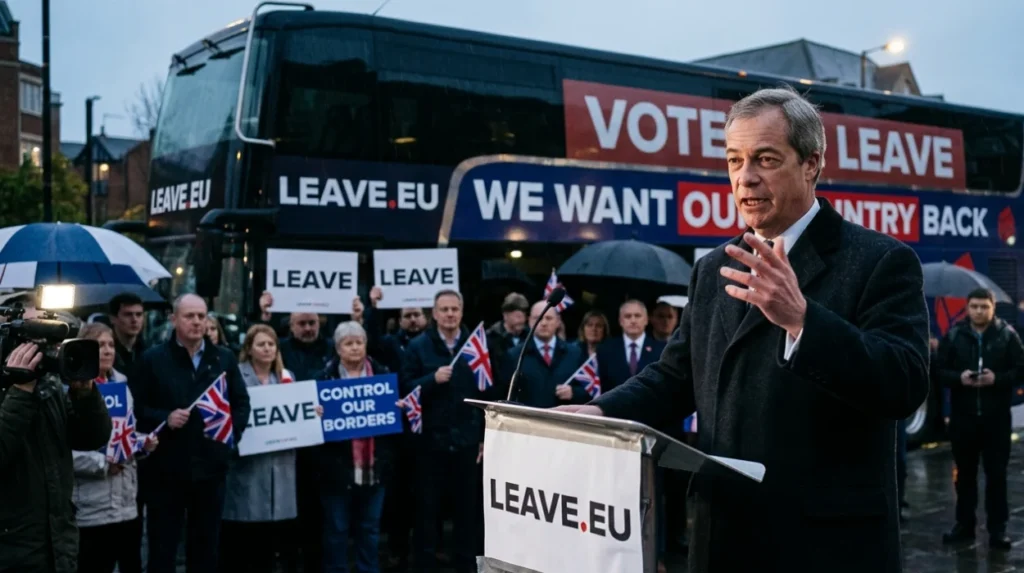
During the 2016 European Union membership referendum, the official designation for the exit campaign was awarded to Vote Leave, led by politicians Boris Johnson and Michael Gove. Farage operated the parallel, unsanctioned campaign group Leave.EU, funded by businessman Arron Banks. Farage focused his rhetoric on national sovereignty, border control, and net migration statistics. He conducted national tours on a customized bus, delivering speeches that connected European Union directives directly to domestic public service pressures. On June 23, 2016, the United Kingdom voted by 51.89% to 48.11% to leave the European Union, an outcome widely credited to the decades of political pressure sustained by Farage.
What political parties did Nigel Farage lead after UKIP?
Nigel Farage co-founded and led the Brexit Party in 2019 to ensure the implementation of the referendum result. He subsequently transitioned this organization into Reform UK, which he currently leads as an insurgent populist force.
The Brexit Party Transition
Following the 2016 referendum, Farage resigned as leader of UKIP, citing the fulfillment of his political ambition. However, observing the parliamentary deadlock under Prime Minister Theresa May regarding the terms of the European Union withdrawal agreement, Farage returned to active politics. In early 2019, he co-founded the Brexit Party alongside Catherine Blaiklock. The party focused on a singular mandate: forcing the government to execute a complete exit from the European Union without retaining formal ties to the European Single Market or the European Union Customs Union.
The 2019 European Parliament Election
The Brexit Party contested the May 2019 European Parliament election just weeks after its official formation. Under Farage’s direction, the party secured 30.5% of the vote and won 29 seats. This decisive victory decimated the electoral standing of the governing Conservative Party, accelerating the resignation of Theresa May as Prime Minister. When Boris Johnson assumed leadership and committed to a firmer Brexit timeline, Farage strategically withdrew 317 Brexit Party candidates from Conservative-held seats during the December 2019 general election to prevent a split in the pro-Brexit vote, enabling Johnson to win an 80-seat majority.
The Formation and Ideology of Reform UK
Following the official departure of the United Kingdom from the European Union on January 31, 2020, the Brexit Party required a structural reorientation. In January 2021, the party was officially renamed Reform UK. Farage altered the platform to focus on internal British governance, institutional reform, and economic policy. The revised platform opposed strict state-mandated lockdowns during the COVID-19 pandemic, advocated for the abolition of the net-zero carbon emissions target, and demanded structural changes to the National Health Service. Farage stepped down from day-to-day operations to become Honorary President, allowing Richard Tice to assume the leadership role.
How did Nigel Farage perform in British general elections?
Nigel Farage contested British parliamentary seats unsuccessfully seven times before winning election to the House of Commons in July 2024. He successfully won the coastal constituency of Clacton, securing a major electoral breakthrough.
Early Parliamentary Attempts
Farage encountered structural barriers within the British first-past-the-post electoral system, which disadvantages smaller political parties with geographically dispersed votes. Between 1994 and 2015, Farage stood for election to the House of Commons seven times across various constituencies.
In his 2010 attempt in Buckingham, Farage challenged the incumbent Speaker of the House, John Bercow, placing third with 17.4% of the vote. In the 2015 general election, he contested South Thanet, securing 32.4% of the vote but losing to the Conservative candidate Craig Mackinlay by 2,812 votes. Despite generating high national vote totals for UKIP—including 3.88 million votes in 2015—the party failed to convert popularity into geographically concentrated parliamentary victories.
The 2024 Clacton Victory
On June 3, 2024, Farage reversed a previous decision to remain on the sidelines and announced he would resume the leadership of Reform UK, launching a campaign for the Essex constituency of Clacton. On July 4, 2024, Farage won the seat with 21,225 votes, establishing a majority of 8,405 over the incumbent Conservative Member of Parliament, Giles Watling. This victory marked Farage’s first successful entry into the British Parliament. Reform UK won a total of five parliamentary seats nationally, capturing 14.3% of the total vote share, which positioned the party as a permanent electoral threat to both the Conservative and Labour parties.
What led to Nigel Farage’s resignation from Parliament in July 2026?
Nigel Farage resigned from the House of Commons on July 8, 2026, amid intense scrutiny regarding his personal finances. The resignation stopped a formal investigation into undeclared financial donations, triggering an immediate by-election.
The Parliamentary Standards Investigations
In April 2026, investigations by national media organizations revealed that Farage had not publicly declared a financial gift valued at £5 million from cryptocurrency billionaire Christopher Harborne prior to the 2024 general election. This prompted an official inquiry by the Parliamentary Commissioner for Standards. In July 2026, a second formal inquiry was initiated into allegations that Farage received undisclosed financial support and resources from George Cottrell, a convicted financial fraudster and former political aide. Under parliamentary rules, lawmakers must disclose all significant financial interests, gifts, and benefits that could influence their actions.
The Resignation Strategy
Rather than awaiting the formal verdict of the Parliamentary Commissioner for Standards—which could have resulted in a suspension from the House of Commons and triggered a constituent-led recall petition—Farage executed a preemptive resignation. His departure from Parliament became official on Wednesday, July 8, 2026. By resigning, Farage automatically paused the parliamentary standards inquiries, as the commissioner’s jurisdiction applies primarily to sitting Members of Parliament.
Triggering the By-Election
Farage immediately announced his intention to contest his own vacated Clacton seat in the subsequent by-election, framing the scenario as a direct contest between himself and the political establishment. To neutralize criticism regarding the public expense of organizing an unscheduled vote, Farage offered to have Reform UK cover the administrative costs of the by-election, which typically exceed £250,000.
In response to this political maneuver, major political entities adopted diverging tactics. While some populist rivals criticized the move as a self-obsessed media distraction, mainstream parties adjusted their candidate strategies for the sudden summer vote, ensuring that the Clacton by-election would serve as a critical referendum on political integrity and populist voter loyalty.
What are Nigel Farage’s core political and economic stances?
Nigel Farage advocates for economic nationalism, strict immigration reductions, and institutional deregulation. His political philosophy combines right-wing populism with libertarian tax policies designed to shrink the size of the British state.
Immigration and Border Control
Immigration policy remains the central pillar of Farage’s political platform. He opposes the 1951 UN Refugee Convention and advocates for the United Kingdom to withdraw from the European Convention on Human Rights. Farage commands public attention by highlighting the arrival of undocumented migrants via small boats across the English Channel, characterizing the phenomenon as an uncontrolled maritime crisis.
He demands a net-zero policy on legal migration, meaning the number of people granted visas to settle permanently in the United Kingdom must not exceed the number of citizens leaving the country. He links high migration volumes to suppressed wages, housing shortages, and increased operational pressures on the National Health Service.
Fiscal Policy and Deregulation
Farage advocates for supply-side economics, aiming to reduce direct taxation on individuals and businesses. His platform includes raising the personal income tax allowance threshold from £12,570 to £20,000, which would exempt millions of low-income earners from income tax entirely.
He supports abolishing the cap on bankers’ bonuses and cutting the main rate of corporation tax to stimulate private investment. Furthermore, Farage seeks the abolition of inheritance tax for estates valued under £2 million. To fund these tax reductions, he proposes cutting government spending by eliminating several public bodies and reforming the funding model of the Civil Service.
Energy and Climate Policy
Farage rejects the consensus on climate transition timelines established by the Climate Change Act 2008. He demands the total repeal of the United Kingdom’s legal commitment to reach net-zero greenhouse gas emissions by 2050. Farage argues that renewable energy subsidies increase domestic electricity bills and undermine industrial competitiveness. His alternative energy strategy relies on exploiting domestic fossil fuel resources, including expanding oil and gas extraction licenses in the North Sea and lifting the national ban on hydraulic fracturing, or fracking, for shale gas.
How has Nigel Farage utilized the media to build his profile?
Nigel Farage bypassed traditional political communication networks by working directly as a television host, radio broadcaster, and digital content creator. This media presence allowed him to retain national political relevance during periods when he held no elected office.
Conventional Broadcasting Roles
Farage developed a career within mainstream broadcasting media to maintain continuous visibility. From 2017 to 2020, he hosted The Nigel Farage Show on LBC, a national talk radio station, using the platform to interact directly with public callers. Following his departure from LBC, Farage joined GB News as a prime-time presenter upon its launch in 2021. His evening program became one of the station’s highest-rated broadcasts, earning him the “News Presenter of the Year” award at the 2023 TRIC Awards. He also worked as a political analyst for Fox News in the United States, commenting on transatlantic populist movements.
Reality Television and Public Relations
In late 2023, Farage participated in the 23rd series of the ITV reality television program I’m a Celebrity…Get Me Out of Here!. His appearance was controversial, drawing thousands of public complaints to the broadcasting regulator Ofcom due to his political viewpoints. Farage advanced to the final round of the competition, finishing in third place. The appearance exposed him to millions of viewers who did not routinely watch political news programming, humanizing his public image and expanding his personal brand to younger demographics before his 2024 parliamentary campaign.
Digital Strategy and Social Media
Farage commands an extensive digital footprint across mainstream social media platforms, including TikTok, X, and YouTube. His content avoids long-form policy documents in favor of short, highly shareable video clips filmed in informal settings such as traditional pubs. This digital communication strategy allows Farage to speak directly to his followers without the editorial filtering of conventional news journalists, a technique that mainstream media scholars identify as a core component of modern populist political mobilization.
What is Nigel Farage’s broader geopolitical and international impact?
Nigel Farage established formal alliances with right-wing populist movements globally, most notably in the United States. His political success with Brexit served as an operational template for nationalist campaigns across Europe and the West.
The Relationship with Donald Trump
Farage maintains a close political and personal relationship with the 45th and 47th President of the United States, Donald Trump. Following Trump’s electoral victory in November 2016, Farage was the first British politician to visit the President-elect at Trump Tower in New York City. Trump publicly suggested that Farage should be appointed as the British Ambassador to the United States, a proposal rejected by the British government. Farage frequently appears at Republican Party rallies, including the Conservative Political Action Conference, where he frames Brexit and the “America First” movement as interconnected parts of a global nationalist revolt against international institutions.
Transatlantic Political Networks
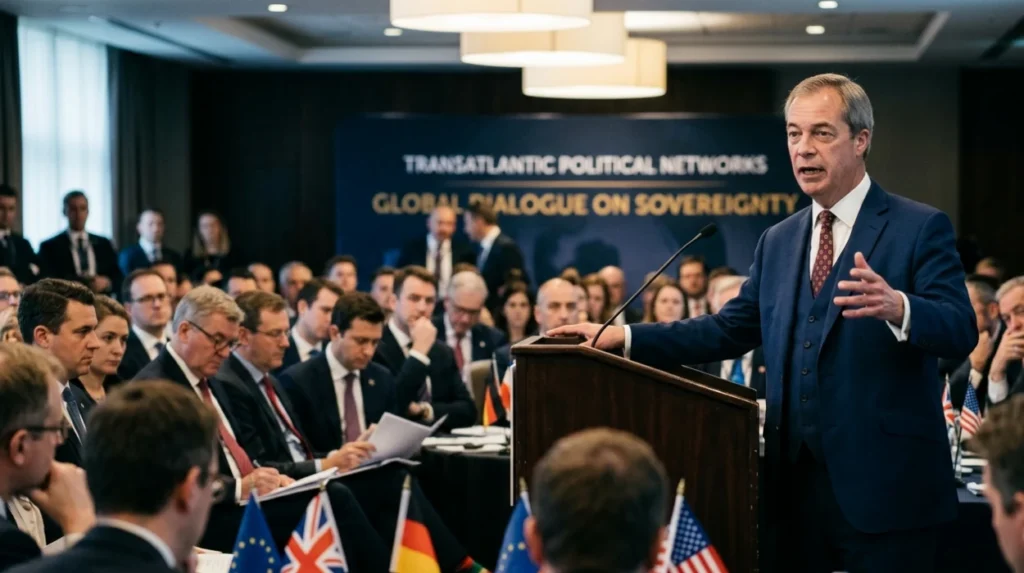
Beyond his individual relationship with Donald Trump, Farage works systematically with right-wing political networks across North America and Europe. He has advised populist politicians in Germany, France, and Italy on how to formulate anti-immigration and anti-Brussels messaging. Farage’s activities include building links with the European Parliament group Europe of Freedom and Direct Democracy, which he chaired to coordinate Eurosceptic voting blocks. His international speeches consistently target global organizations such as the World Economic Forum, the World Health Organization, and the United Nations, arguing that these bodies dilute national self-determination.
What are the main criticisms and controversies surrounding Nigel Farage?
Nigel Farage faces persistent criticism regarding his rhetorical tactics, campaign finances, and accusations of stoking racial and social divisions. Detractors argue that his populist approach undermines democratic norms and harms social cohesion.
Accusations of Xenophobia and Racism
Critics frequently accuse Farage of utilizing xenophobic rhetoric to win elections. During the 2016 Brexit referendum, he unveiled a Leave.EU campaign poster titled “Breaking Point,” which depicted a long queue of dark-skinned migrants arriving at the European Union border. The advertisement drew condemnation from across the political spectrum, with opponents accusing Farage of using Nazi-style propaganda tactics to incite fear.
Additionally, in December 2025, twenty-five former pupils and a teacher from Dulwich College signed an open letter published in The Guardian, demanding Farage apologize for alleged fascist and antisemitic behavior during his school years. Reform UK dismissed the letter as an outdated, politically motivated attempt to discredit Farage.
Financial Opacity and Investigations
The financial operations supporting Farage’s political endeavors have been subject to multiple regulatory reviews. The European Parliament previously docked Farage’s salary to recover misspent EU funds intended for parliamentary assistants but allegedly diverted to support UKIP party operations.
His close association with wealthy donors, including the insurance tycoon Arron Banks, has faced scrutiny from the National Crime Agency and the Electoral Commission. The July 2026 financial scandal involving millions in undeclared cryptocurrency gifts from Christopher Harborne represents the latest event in a long pattern of controversies concerning financial disclosure and elite backing.
Institutional Disruption
Constitutional scholars and traditional politicians argue that Farage’s populist rhetoric devalues vital democratic institutions. By consistently framing politics as a struggle between “the clean, ordinary people” and “a corrupt political class,” Farage is accused of eroding public trust in the civil service, the judiciary, and the parliament itself. His detractors emphasize that despite his anti-establishment branding, Farage is a privately educated former commodities trader who has spent decades within professional political structures, utilizing institutional mechanisms to maximize personal media leverage.
What is Nigel Farage’s long-term legacy in British politics?
Nigel Farage redefined modern British governance by forcing the realignment of the traditional two-party system and permanently shifting mainstream policy positions to the right. His legacy is defined by the structural transformation of the United Kingdom’s external and internal affairs.
Realignment of the Two-Party System
For over a century, British politics was dominated by the binary choice between the Conservative and Labour parties. Farage fractured this stability by creating electoral vehicles that captured millions of votes from both traditional bases. By mobilizing working-class voters in former industrial towns and conservative voters in coastal areas, he forced the mainstream parties to shift their own policy goals to survive. The transformation of the Conservative Party into an explicitly Eurosceptic organization under leaders like Boris Johnson and subsequent figures is a direct consequence of the electoral pressure applied by Farage.
The Reality of Brexit
The structural departure of the United Kingdom from the European Union remains the most tangible outcome of Farage’s political career. This geopolitical shift altered British trade regulations, immigration laws, economic frameworks, and foreign policy alliances. While critics view Brexit as an act of economic self-harm that reduced GDP growth and complicated European cooperation, Farage’s supporters view it as a historic restoration of national independence. The ongoing economic and social adjustments to life outside the European Union ensure that Farage’s life’s work remains central to contemporary British political debate.
The Future of Right-Wing Populism
Nigel Farage’s career demonstrates that an individual politician can exert immense control over national policy without managing a conventional government administration. Through Reform UK, Farage established a durable populist platform designed to influence British politics for decades. His strategic combination of media showmanship, digital communication, and targeted electoral disruption offers an established blueprint for populist movements worldwide. Whether operating inside the halls of Westminster or campaigning from the outside, Farage has ensured that national identity, border restriction, and anti-globalism remain central forces in British public life.
Who is Nigel Farage?
Nigel Farage is a British politician, broadcaster, and leader of Reform UK. He is best known for leading the campaign for the United Kingdom to leave the European Union and for his long-standing advocacy of Euroscepticism.