Key Points
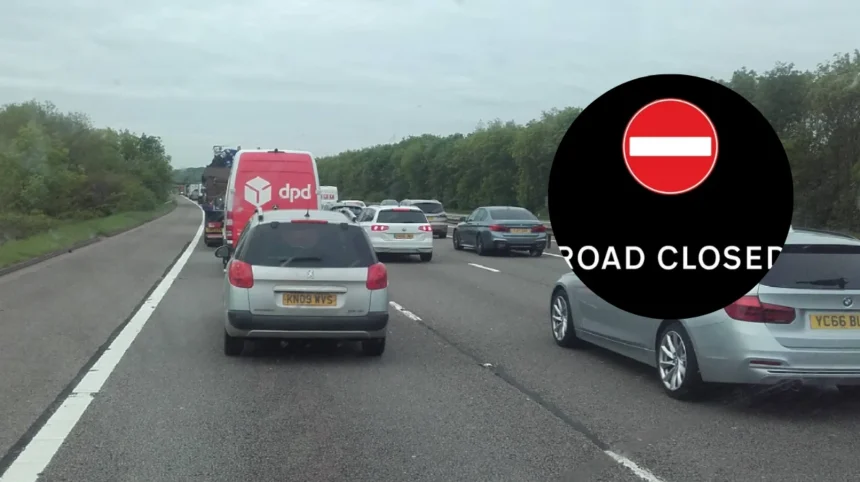
- A crash on the M40 southbound near Lewknor has closed two of the three lanes between Junction 6 (Watlington) and Junction 5 (Stokenchurch)
- The incident was first reported at around midday on Monday, 22 June 2026
- As of early afternoon, two out of three lanes are now open, but National Highways still reports 40 minutes of delay for some drivers
- Current delays have reduced to around 20 minutes as traffic begins to clear
- Normal traffic conditions are expected to return by 2.15pm
- The crash is causing long delays for southbound travelers between J6 and J5
- National Highways is managing the incident and overseeing lane reopenings
- No official information has been released yet regarding injuries or the number of vehicles involved
- Drivers are advised to allow extra time or consider alternative routes if travelling through Oxfordshire this afternoon
Oxford (Oxford Daily) June 22, 2026 – Two out of the three lanes on the M40 southbound remain closed after a crash near Lewknor, causing significant delays between Junction 6 near Watlington and Junction 5 near Stokenchurch. The incident was first reported at around midday, and National Highways is still managing the scene as traffic slowly begins to clear. As reported by the editorial team at Herald Series in their live traffic blog update,
- Key Points
- How severe are the current M40 delays and which lanes are closed?
- When did the M40 crash happen and when will traffic return to normal?
- Which routes are affected and what alternative paths can drivers take?
- Are there any injuries or safety concerns reported in the M40 crash?
- Background: What National Highways Typically Does During M40 Lane Closures
- Prediction: How This M40 Crash Development Will affect Oxfordshire Drivers and Commuters
“There are reports of a crash on the M40 southbound near Lewknor which is causing long delays between J6 near Watlington and J5 near Stokenchurch due to the closure of two lanes”.
At the time of the latest update, two of the three lanes are now open, but drivers should still expect substantial delays. National Highways continues to report 40 minutes of delay for some southbound traffic, though current delays have reduced to around 20 minutes as the situation improves. Normal traffic conditions are expected to return from 2.15pm, according to the live traffic blog maintained by local reporters covering Oxfordshire road incidents.
How severe are the current M40 delays and which lanes are closed?
The M40 southbound carriageway between Junction 6 and Junction 5 has two lanes closed, leaving only one lane plus the hard shoulder potentially available for traffic. As reported by Herald Series, “There are reports of a crash on the M40 between J6 and J5 as closed lanes cause delays”. This lane configuration has created a bottleneck, forcing southbound vehicles to merge into a single lane and significantly reducing the road’s capacity.
As of the latest update on Monday, 22 June 2026, two out of the three lanes are open, marking progress since the incident began. However, National Highways is still reporting 40 minutes of delay for some drivers, particularly those caught further back in the queue when the lanes first closed. Current delays have dropped to around 20 minutes, indicating that the situation is improving but remains problematic for afternoon travelers.
The closure affects the stretch near Lewknor, a village in Oxfordshire situated between Watlington (J6) and Stokenchurch (J5). This section of the M40 is a key route for traffic traveling between London and the Midlands, meaning disruptions here have wider implications for regional transport.
When did the M40 crash happen and when will traffic return to normal?
The incident was first reported at around midday on Monday, 22 June 2026. According to the live traffic blog updating Oxfordshire motorists, “Good afternoon and welcome to this blog, updating you about traffic on the M40 in Oxfordshire due to a crash between J6 and J5”. This timestamp places the crash in the early afternoon period, disrupting the typical midday and early afternoon traffic flow.
National Highways has indicated that normal traffic conditions are expected from 2.15pm. This means drivers should anticipate roughly two hours of disrupted traffic from the time the incident was first reported. The timeline suggests that emergency services, road crews, and National Highways teams are working efficiently to clear the scene and reopen all lanes.
The gap between midday and 2.15pm allows for approximately 135 minutes of incident management, including crash investigation, vehicle removal, and any necessary road surface repairs. This timeframe is consistent with typical motorway crash responses where two lanes must be closed for safety.
Which routes are affected and what alternative paths can drivers take?
The M40 southbound between Junction 6 (Watlington) and Junction 5 (Stokenchurch) is the primary affected route. This stretch serves travelers heading from the Midlands and Birmingham toward London, as well as local Oxfordshire traffic moving between these junctions. The closure near Lewknor impacts a key section of the motorway that connects rural Oxfordshire with major urban centers.
Drivers caught in the delay may consider alternative routes depending on their destination:
- For London-bound traffic: The A40 provides a parallel route west of the M40, though it is slower and more suitable for local traffic rather than long-distance travelers.
- For Oxford-bound traffic: Exiting at Junction 5 and using local roads through Stokenchurch or taking the A34 further west may offer alternatives.
- For Midlands-bound traffic going north: Drivers already south of the crash may need to wait, as there are limited northbound alternatives in this rural section.
National Highways typically updates traffic information via their website and social media channels during such incidents, and drivers are advised to check these sources for real-time updates.
Are there any injuries or safety concerns reported in the M40 crash?
No official information has been released yet regarding injuries or the number of vehicles involved in the M40 crash near Lewknor. The Herald Series blog update and National Highways statements have focused entirely on traffic impacts, lane closures, and delay estimates without mentioning casualty details.
In motorway crash incidents, emergency services often delay injury announcements until they have confirmed details with hospitals and conducted full scene assessments. This is standard practice to protect the privacy of those involved and to avoid spreading unconfirmed information.
The closure of two out of three lanes suggests the crash involved significant damage or required extensive emergency response, but the exact nature remains unconfirmed. Drivers passing the scene should remain alert for emergency vehicles, road crews, and potential debris.
Background: What National Highways Typically Does During M40 Lane Closures
National Highways, the government body responsible for England’s major road network, follows a structured approach when managing motorway incidents like the M40 crash near Lewknor. When a crash closes multiple lanes, National Highways typically coordinates with emergency services (police, fire, and ambulance), secures the scene, and begins traffic management using temporary signage and lane viaets.
As documented in previous M40 incident updates, National Highways provides real-time delay estimates through their website and traffic information services. In a similar incident on the M40 northbound between J5 and J6 in February 2026, National Highways reported lane closures and clearance times with comparable precision, noting expected clearances within 15-minute windows.
The organization also works to reopen lanes as quickly as possible while maintaining safety. In the current incident, the reopening of two out of three lanes from the initial full closure demonstrates this approach. National Highways aims to restore normal conditions within a predictable timeframe, as seen in their projection of 2.15pm for full recovery.
Prediction: How This M40 Crash Development Will affect Oxfordshire Drivers and Commuters
The M40 crash between J6 and J5 will have measurable impacts on Oxfordshire drivers, commuters, and regional traffic patterns throughout the afternoon of Monday, 22 June 2026. With delays ranging from 20 to 40 minutes and normal conditions expected only by 2.15pm, southbound travelers face significant disruptions to their schedules.
For daily commuters traveling between the Midlands and London, the delay adds unpredictable time to their journeys. Many may need to adjust work start times, miss appointments, or face extended hours on the road. The 40-minute peak delay could translate to missed connections for those relying on precise timing.
For local Oxfordshire residents using the M40 for regional travel, the closure restricts access between Watlington and Stokenchurch, potentially forcing detours onto slower A-roads. This increases travel time for local trips and may congest alternative routes like the A40 or A34.
For businesses relying on timely logistics and deliveries through this section, the incident could delay freight movement, affecting supply chains and customer expectations. Trucking companies often plan around National Highways’ predicted clearance times, but the 40-minute delay window introduces uncertainty.
For emergency services and public transport, the congestion may delay response times for any secondary incidents in the area and complicate bus routes that use the M40 corridor.
Looking forward, this incident highlights the vulnerability of key motorway sections to single-point failures. As summer travel increases in June 2026, similar crashes could cause even longer delays if traffic volumes are higher. Oxfordshire drivers should monitor National Highways updates before traveling and consider flexible timing to avoid peak disruption periods around midday to 2.15pm.