Key Points
- Conservative councillors in Westminster have vowed to mount a legal challenge to Sadiq Khan’s Oxford Street pedestrianisation plan after regaining control of Westminster Council.
- The party said it would set up a legal fighting fund as one of its early actions in office.
- Conservative Westminster Group leader Paul Swaddle said the council would challenge the plan in court and “force” the Mayor of London to listen to local people.
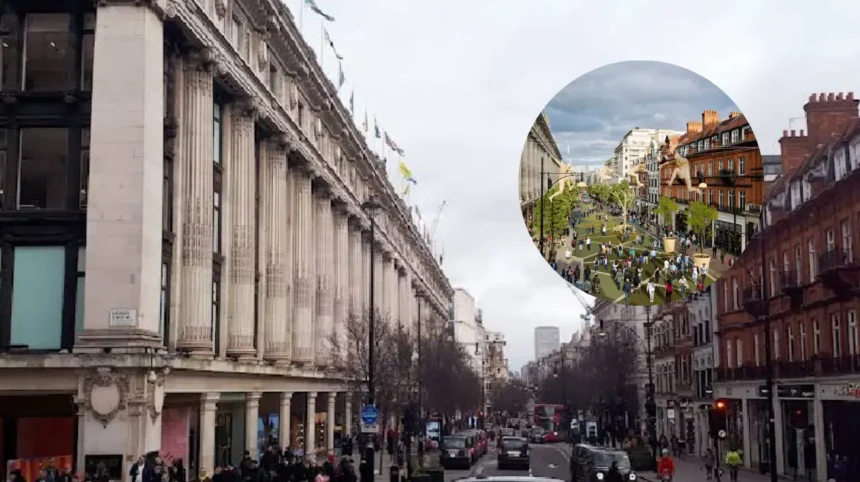
- The row centres on the Mayor’s powers over Oxford Street and the long-running debate over whether the West End should be pedestrianised.
- Earlier coverage showed the issue was politically sensitive for Labour too, with previous council leaders avoiding explicit support for pedestrianisation before the election.
Oxford(Oxford Daily)May 12, 2026 – Conservative councillors in Westminster have pledged to fight Sir Sadiq Khan’s Oxford Street pedestrianisation plan after their local election win returned the council to Tory control.
As reported by the Local Democracy Reporting Service and carried by the Evening Standard and Local Government Lawyer, the incoming Conservative leadership said it would establish a legal fund to challenge the Mayor of London’s scheme. The move was presented as one of the first priorities of the new administration, signalling that Oxford Street is likely to remain a major political battleground in central London.
The dispute is about a stretch of one of the capital’s most famous shopping streets, where transport, access, business and public realm arguments have been in tension for years. Conservatives say they want to protect bus routes and maintain access for people who rely on them, while supporters of pedestrianisation argue that removing traffic could improve the area for shoppers and visitors.
Why is it controversial?
The issue has long divided London politicians, Westminster residents and businesses because Oxford Street sits at the centre of both local transport planning and the wider retail economy. Reports have suggested that the Mayor of London has been given powers over this part of Oxford Street by the Secretary of State, which raises the stakes of any legal challenge from the council.
The BBC previously reported that the subject was sensitive even when Labour controlled Westminster, with the council leadership reluctant to campaign openly on pedestrianisation because of its political risk. That background helps explain why the latest Conservative pledge is being framed not just as a policy disagreement but as a symbolic fight over who should shape the future of the West End.
What did the Conservatives say?
According to the Local Government Lawyer report, Conservative Westminster Group leader Paul Swaddle said the party would create a legal fighting fund to challenge Sadiq Khan in court. He also said the council would aim to “force him to listen to local people”, presenting the plan as a defence of residents and transport users rather than a simple rejection of change.
The Evening Standard reported that the Conservatives were preparing to mount the challenge after regaining control of the council, and that the move formed part of their early agenda. The central political message is clear: the new administration intends to use its fresh mandate to slow, block or reshape the Mayor’s plans if possible.
What has been reported elsewhere?
The BBC has previously described Oxford Street pedestrianisation as a politically difficult subject for Labour, noting that the proposal was considered too controversial to place at the centre of an election campaign. Another BBC report highlighted how Westminster had become a key battleground, with control of the council carrying outsized importance because of the street’s economic and symbolic weight.
A report published by Fitzrovia News also said the incoming Conservative leadership planned to fight the Mayor over the pedestrianisation proposal and had vowed to set up a legal fund. Taken together, the coverage points to a coordinated Conservative stance rather than a one-off comment, suggesting the issue may quickly move from campaign rhetoric to formal action.
What happens next?
Any legal challenge would likely examine the scope of the Mayor’s authority, the council’s powers, and whether the pedestrianisation plan followed the correct procedural steps. If the Conservatives pursue the case aggressively, the dispute could delay implementation and create fresh uncertainty for businesses, bus users and commuters in the West End.
The political impact may be just as significant as the legal one, because Westminster Council control can shape how London-wide schemes are received on the ground. If the new council uses its platform to oppose the project, the row could become a test of how far local government can resist mayoral transport policy.
Background of the development
Oxford Street pedestrianisation has been debated for years because it touches on transport, retail revival, tourism and local access all at once. The latest dispute follows a long period in which the future of the street has been politically sensitive, with different councils and parties cautious about taking a firm public line.
Westminster Council is especially important because it covers one of London’s most commercially valuable districts, so its position carries influence beyond the borough itself. That is why the Conservatives’ return to power matters: it gives opponents of the scheme an institutional platform from which to resist the Mayor’s plans.
Prediction
For local businesses, bus passengers and residents around Oxford Street, the most immediate effect is likely to be uncertainty. Even if the pedestrianisation plan eventually goes ahead, a legal fight could slow timelines, raise costs and keep the future of the street unsettled for longer.
For London politics, the development could sharpen the divide between City Hall and Westminster Council and turn Oxford Street into a defining test case for urban policy in the capital. If the challenge gains momentum, it may also encourage other councils to push back more forcefully against mayoral schemes that affect transport and high streets.