Sheldonian Theatre’s intricate ceiling paintings are one of Oxford’s most dazzling visual treasures, working as both a masterpiece of 17th‑century art and a coded message about knowledge, religion, and the birth of modern learning. This ceiling, painted in oil on canvas by King Charles II’s official court artist Robert Streater, still dominates the space above visitors’ heads, inviting them to look up and decode its allegories of Truth, the Liberal Arts, and the defeat of Ignorance.
- What the Sheldonian Theatre is
- The artist behind the ceiling: Robert Streater
- Design and structure of the ceiling
- The central allegory: “Truth Descending upon the Arts and Sciences”
- Depictions of the Liberal Arts and university subjects
- Restoration and conservation of the ceiling
- The ceiling as a symbol of Oxford’s cultural identity
- The Sheldonian in modern Oxford life
Below, the article is structured for SEO and readability, targeting Oxford‑centric phrases such as “Sheldonian Theatre ceiling paintings,” “Sheldonian Theatre Oxford,” “Robert Streater ceiling,” and “evergreen Oxford history art topic.”
What the Sheldonian Theatre is
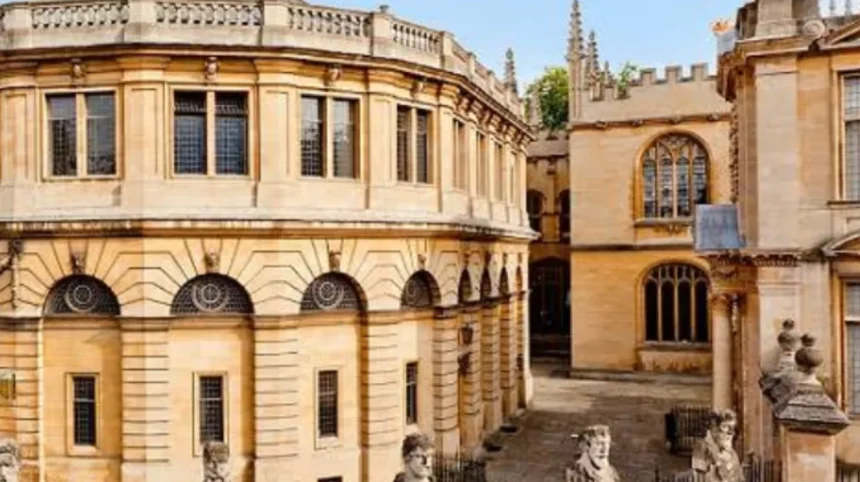
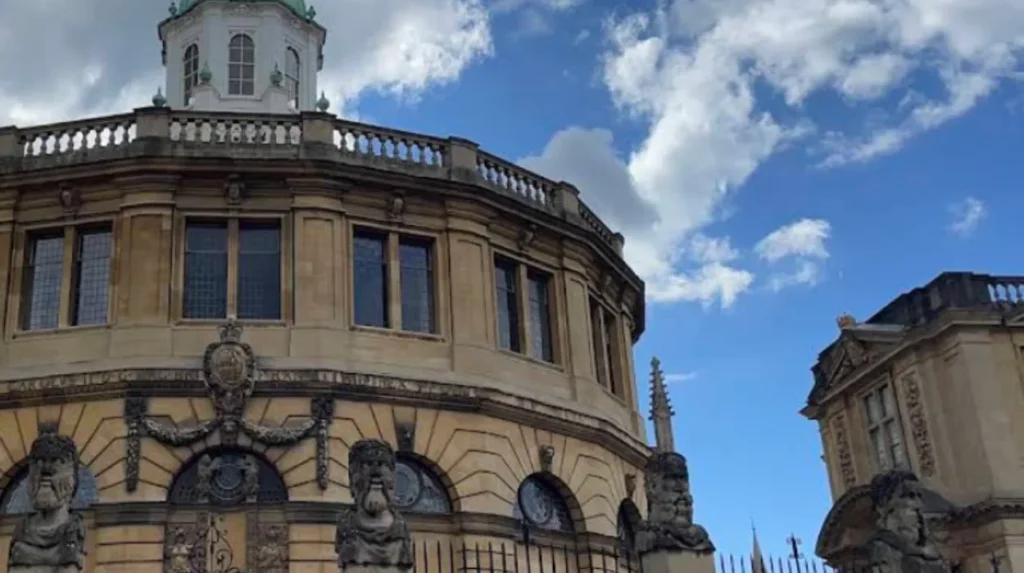
The Sheldonian Theatre stands just north of the Bodleian Library in Oxford, a short stroll from Broad Street and the heart of the city’s historic core. Designed by Sir Christopher Wren and completed in 1669, the building was conceived as a ceremonial and academic hall for the University of Oxford, hosting Encaenia, degree ceremonies, concerts, and public lectures. Its architecture evokes a Roman theatre, with a sloping roof and galleries that frame the central space, but the true visual spectacle is on the inside: the ceiling fresco stretched above the audience like a painted sky.
The artist behind the ceiling: Robert Streater
The ceiling was executed by Robert Streater (also spelled Streeter), who held the title of Serjeant‑Painter to King Charles II and served as the crown’s principal decorative painter. Streater was commissioned to create a grand allegorical ceiling for the Sheldonian, working in his studio at Whitehall in London before the finished panels were shipped up the Thames to Oxford by barge. The work was completed in 1668–69, during the early years of the Restoration, a period when the monarchy and the older universities were keen to reassert their cultural authority after the Civil War and Interregnum.
Streater’s composition was not simply a decorative flourish; it was a carefully planned visual manifesto about the revival of learning and the triumph of knowledge over the forces that had suppressed it.
Design and structure of the ceiling
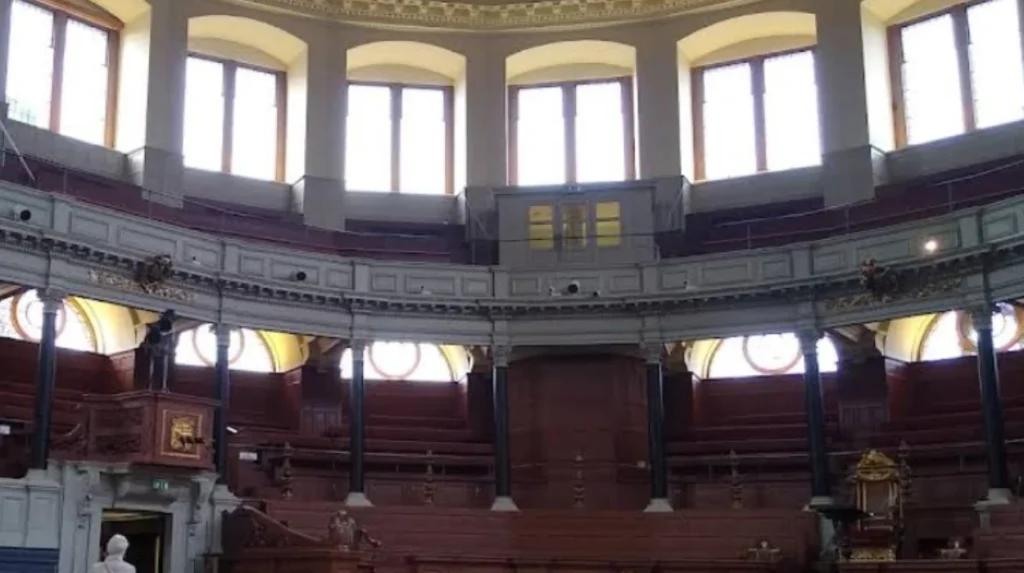
The ceiling is made up of thirty‑two separate oil‑on‑canvas panels arranged in a grid across the flat, coffered roof of the Sheldonian Theatre. Each panel is a self‑contained composition, painted independently and then fitted together to form a larger, unified tableau high above the audience. This modular design allowed Streater to work efficiently in his studio and enabled later conservation to remove and restore individual panels without dismantling the entire ceiling at once.
Structurally, the ceiling reflects Wren’s vision of a Roman‑style theatre open to the sky. Carved, gilded wooden ropes stretch across the roof, giving the illusion that they once supported a great crimson awning that could be unfurled by putti to protect the audience from the elements. This theatrical framing heightens the drama of Streater’s painted scene, turning the ceiling into a kind of stage set suspended overhead.
The central allegory: “Truth Descending upon the Arts and Sciences”
The overall scheme of the ceiling is traditionally described under the title Truth Descending upon the Arts and Sciences, a Baroque allegory that depicts Truth as a radiant female figure descending from the heavens to illuminate the University and its disciplines. In this allegory, Truth is shown dispersing the dark clouds of Ignorance and driving away the figures of Envy, Malice, Rapine (violence or plunder), and related vices.
For Oxford in the late 1660s, this imagery was deeply political and cultural. The Restoration of the monarchy in 1660 was being framed as a return to order, learning, and piety after the upheaval of the Civil War and the Interregnum, when Puritan and Parliamentarian forces had been hostile to traditional university life. By depicting Knowledge and Truth triumphing over Ignorance, Streater’s ceiling signalled that Oxford was once again a place where the arts, sciences, and theology could flourish under royal and religious patronage.
Depictions of the Liberal Arts and university subjects
One of the most engaging features of the ceiling is the way it incorporates the traditional Liberal Arts and various university disciplines. Each panel uses personification to represent fields such as Grammar, Rhetoric, Logic, Arithmetic, Geometry, Music, and Astronomy, alongside more advanced faculties like Theology, Law, and Medicine. These figures are often shown in classical poses, equipped with symbolic objects—scrolls, compasses, globes, musical instruments—that identify their disciplines at a glance.
For an Oxford visitor today, this visual catalogue of learning acts almost like a pre‑modern textbook written in paint. Tour‑guide materials at the Sheldonian frequently invite audiences to look closely and see how many subjects they can identify, making the ceiling a kind of interactive puzzle for students, historians, and general visitors alike.
Restoration and conservation of the ceiling
The Sheldonian ceiling has endured for over three centuries, but time and environmental factors took a toll on the original oil‑on‑canvas panels. In the early 21st century, a major conservation project was undertaken to stabilise and restore Streater’s work. Between roughly 2004 and 2008, the thirty‑two panels were carefully removed from the ceiling, cleaned, and repaired.
During this restoration, conservators replaced weakened linings, mended tears in the canvas, and removed layers of over‑paint and discoloured varnish that had accumulated over the years. This painstaking work allowed modern audiences to see the ceiling much closer to how it would have appeared in the late 17th century, with brighter colours and clearer detail. The project also reinforced the structure that supports the panels, ensuring that the ceiling can continue to be admired by future generations of Oxford students and visitors.
The ceiling as a symbol of Oxford’s cultural identity
Beyond its technical and artistic interest, the Sheldonian ceiling is a powerful symbol of Oxford’s self‑image as a centre of learning. The imagery of Truth descending on the Arts and Sciences echoes the University’s long‑standing role in British intellectual life, from medieval theology through the scientific revolution and into the modern era. At the same time, the allegorical defeat of Envy, Malice, and Ignorance can be read as a statement of confidence in reason, scholarship, and the communal life of an academic community.
For residents of Oxford and for visitors drawn to the city’s historic colleges and libraries, the ceiling offers a concentrated visual expression of what the University represents: the pursuit of knowledge, the defence of intellectual freedom, and the belief that education should be protected from dogmatism and violence. Standing beneath the painted sky of the Sheldonian, it is easy to understand why this space has remained a focal point for Oxford’s ceremonial and artistic life for more than three and a half centuries.
The Sheldonian in modern Oxford life
Today, the Sheldonian Theatre continues to serve multiple roles in Oxford’s civic and academic calendar. It is still the venue for Encaenia, the University’s annual ceremony honouring honorary degree recipients, and for various musical and theatrical performances. The building also hosts public tours that allow visitors to study the ceiling at close quarters, often with the help of guides who explain the symbolism and history of Streater’s panels.
For an Oxford‑centric audience, the Sheldonian operates as both a working ceremonial space and a preserved historical artefact. The ceiling, in particular, bridges these two functions: it is a functional architectural feature that must be maintained for structural and safety reasons, yet it is also a museum‑quality artwork that demands care and scholarly attention. This dual status makes the building a compelling example of how Oxford’s historic fabric is woven into the everyday life of the city rather than being locked away behind museum glass.
Who painted the ceiling of the Sheldonian Theatre?
The ceiling of the Sheldonian Theatre was painted by Robert Streater (also known as Streeter), Serjeant‑Painter to King Charles II, who completed the work in 1668–69. The thirty‑two oil‑on‑canvas panels depict the allegory Truth Descending upon the Arts and Sciences above the audience.
What is the history of the Sheldonian Theatre?
The Sheldonian Theatre was built between 1664 and 1669 to designs by Sir Christopher Wren, funded by Gilbert Sheldon, then Archbishop of Canterbury and former Chancellor of the University of Oxford. It was created as a ceremonial hall for university events such as Encaenia and degree ceremonies, replacing the need to hold such occasions in a church.
What is considered the most beautiful painting in the world?
There is no single definitive answer, but many art scholars and writers have argued that Vermeer’s View of Delft is among the most beautiful paintings ever created. Others point to works such as Piero della Francesca’s Resurrection of Christ as contenders for the title, showing that the “most beautiful painting” is ultimately a matter of personal and critical opinion.
What is the best theatre in Oxford?
New Theatre Oxford, on George Street, is generally regarded as the city’s main commercial theatre, hosting large‑scale musicals, concerts, and touring productions. Alongside smaller venues such as the Pegasus Theatre and the Oxford Playhouse, New Theatre is often seen as the top choice for mainstream, professional theatre in Oxford.
Which Oxford college was Harry Potter filmed in?
Parts of the Harry Potter films were shot at Christ Church, one of Oxford’s most famous colleges, whose Great Hall inspired the design of the Hogwarts dining hall. While the exterior of the school is largely a studio creation, the cloisters and quadrangle of Christ Church are recognisable in several scenes from the series.